Research & Development World

  • R&D World Home
  • Topics
    • Aerospace
    • Automotive
    • Biotech
    • Careers
    • Chemistry
    • Environment
    • Energy
    • Life Science
    • Material Science
    • R&D Management
    • Physics
  • Technology
    • 3D Printing
    • A.I./Robotics
    • Software
    • Battery Technology
    • Controlled Environments
      • Cleanrooms
      • Graphene
      • Lasers
      • Regulations/Standards
      • Sensors
    • Imaging
    • Nanotechnology
    • Scientific Computing
      • Big Data
      • HPC/Supercomputing
      • Informatics
      • Security
    • Semiconductors
  • R&D Market Pulse
  • R&D 100
    • 2025 R&D 100 Award Winners
    • 2025 Professional Award Winners
    • 2025 Special Recognition Winners
    • R&D 100 Awards Event
    • R&D 100 Submissions
    • Winner Archive
  • Resources
    • Research Reports
    • Digital Issues
    • Educational Assets
    • Subscribe
    • Video
    • Webinars
    • Content submission guidelines for R&D World
  • Global Funding Forecast
  • Top Labs
  • Advertise
  • SUBSCRIBE

XrFuse 1 and XrFuse 2 target laboratory fusion sample preparation

By Brian Buntz | March 27, 2026

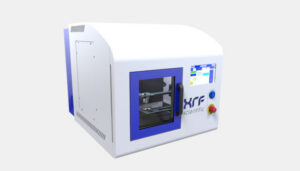
XRF Scientific used Analytica 2026 in Munich to showcase the xrFuse 1 (pictured) and xrFuse 2, its next-generation electric fusion systems designed for automated sample preparation ahead of XRF and ICP analysis. Both instruments launched in January 2026 and reach a maximum operating temperature of 1,300 °C, a step up from the company’s earlier specs. The xrFuse 1 is a compact, single-position unit (upgradeable to two positions) that produces up to four beads per hour, targeting lower-throughput labs or specialized applications. The larger xrFuse 2 scales to eight beads per hour for higher-volume workflows.

Both systems are fully electric, cold-to-cold machines built on what XRF Scientific describes as 25-plus years of fusion technology originally developed for high-uptime iron ore analysis in Australia. A proprietary quick change-out mechanism lets users switch between XRF bead and ICP solution preparation in seconds. Ceramic cradles and holders eliminate contamination from non-sample sources, and all external surfaces are designed, using infrared thermal modeling, to remain safe to touch during operation. The instruments carry CE certification.

The xrFuse line sits within a broader XRF Scientific portfolio that includes the gas-powered Phoenix II and the six-position xrFuse 6 for labs needing throughput up to 30 beads per hour. Analytica 2026, running March 24–27, drew more than 1,100 exhibitors across five halls covering laboratory technology, analytical instrumentation, and biotechnology.

XrFuse — Key Specs
xrFuse 1 max temp 1300 °C
xrFuse 1 throughput Up to 4 beads/hour
xrFuse 1 dimensions 540 × 710 × 680 mm
xrFuse 2 max temp 1300 °C
xrFuse 2 throughput Up to 10 beads/hour
xrFuse 2 dimensions 540 × 940 × 680 mm

Both systems launched January 2026.

Announced at Analytica 2026, Munich, March 24–27.
Related Articles Read More >

Waters targets earlier thermal runaway detection with whole-cell coin cell differential scanning calorimeter
group of scientists working at the laboratory
Benchling bets lab automation can ground AI co-scientists in the physical world
For AI co-scientists to scale, scientists have to trust them. The architectural bets to earn it vary.
scientist working with microplate in a pharmaceutical lab / biomedical engineer working with samples in microplate in the laboratory
Pistoia Alliance on why 69% of life sciences firms can’t measure AI’s impact, and the architectural shift that could change that
rd newsletter
EXPAND YOUR KNOWLEDGE AND STAY CONNECTED
Get the latest info on technologies, trends, and strategies in Research & Development.

R&D World Digital Issues

Fall 2025 issue

Browse the most current issue of R&D World and back issues in an easy to use high quality format. Clip, share and download with the leading R&D magazine today.

R&D 100 Awards
Research & Development World
  • Subscribe to R&D World Magazine
  • Sign up for R&D World’s newsletter
  • Contact Us
  • About Us
  • Drug Discovery & Development
  • Pharmaceutical Processing
  • Global Funding Forecast

Copyright © 2026 WTWH Media LLC. All Rights Reserved. The material on this site may not be reproduced, distributed, transmitted, cached or otherwise used, except with the prior written permission of WTWH Media
Privacy Policy | Advertising | About Us

Search R&D World

  • R&D World Home
  • Topics
    • Aerospace
    • Automotive
    • Biotech
    • Careers
    • Chemistry
    • Environment
    • Energy
    • Life Science
    • Material Science
    • R&D Management
    • Physics
  • Technology
    • 3D Printing
    • A.I./Robotics
    • Software
    • Battery Technology
    • Controlled Environments
      • Cleanrooms
      • Graphene
      • Lasers
      • Regulations/Standards
      • Sensors
    • Imaging
    • Nanotechnology
    • Scientific Computing
      • Big Data
      • HPC/Supercomputing
      • Informatics
      • Security
    • Semiconductors
  • R&D Market Pulse
  • R&D 100
    • 2025 R&D 100 Award Winners
    • 2025 Professional Award Winners
    • 2025 Special Recognition Winners
    • R&D 100 Awards Event
    • R&D 100 Submissions
    • Winner Archive
  • Resources
    • Research Reports
    • Digital Issues
    • Educational Assets
    • Subscribe
    • Video
    • Webinars
    • Content submission guidelines for R&D World
  • Global Funding Forecast
  • Top Labs
  • Advertise
  • SUBSCRIBE