Research & Development World

  • R&D World Home
  • Topics
    • Aerospace
    • Automotive
    • Biotech
    • Careers
    • Chemistry
    • Environment
    • Energy
    • Life Science
    • Material Science
    • R&D Management
    • Physics
  • Technology
    • 3D Printing
    • A.I./Robotics
    • Software
    • Battery Technology
    • Controlled Environments
      • Cleanrooms
      • Graphene
      • Lasers
      • Regulations/Standards
      • Sensors
    • Imaging
    • Nanotechnology
    • Scientific Computing
      • Big Data
      • HPC/Supercomputing
      • Informatics
      • Security
    • Semiconductors
  • R&D Market Pulse
  • R&D 100
    • 2025 R&D 100 Award Winners
    • 2025 Professional Award Winners
    • 2025 Special Recognition Winners
    • R&D 100 Awards Event
    • R&D 100 Submissions
    • Winner Archive
  • Resources
    • Research Reports
    • Digital Issues
    • Educational Assets
    • Subscribe
    • Video
    • Webinars
    • Content submission guidelines for R&D World
  • Global Funding Forecast
  • Top Labs
  • Advertise
  • SUBSCRIBE

First net zero mass spectrometer launched to support greener future

By Heather Hall | September 23, 2021

The launch of the world’s first net zero mass spectrometer (MS) will make it easier than ever for scientists working across geoscience, food and beverage, environmental science and forensics to practice science sustainably.

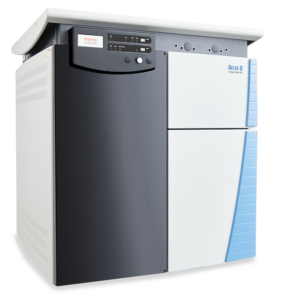
The Thermo Scientific Delta Q Isotope Ratio Mass Spectrometer (IRMS) is a next generation gas IRMS designed to enable detailed analysis with greater precision and accuracy. In addition to its improved specifications, including an upgrade in software to Qtegra ISDS to dramatically improve ease-of-use and laboratory productivity, the system’s carbon footprint will be neutralized, allowing scientists to carry out their work, while minimizing their environmental impact. The Delta Q IRMS is the first product to be released as part of the IsoFootprint campaign, an initiative to permanently remove CO₂ emissions associated with the manufacture and supply chain of all new inorganic IRMS products. The Inorganic MS (IOMS) team at Thermo Fisher has committed to removing all embodied carbon in its new instrumentation, using technologies, like direct air capture and bio-oil sequestration, that lock away carbon from the atmosphere permanently.

“The Delta Q IRMS, and our IsoFootprint initiative, is a major step forward in our commitment to supporting sustainable science,” said Chris Cascella, general manager, inorganic mass spectrometry, chromatography and mass spectrometry, Thermo Fisher Scientific. “With the world in climate crisis, we want to be sure we play our part in limiting the damaging environmental impacts of climate change. By 2026, our IOMS instruments will become carbon neutral, removing 4500 tCO₂e from the atmosphere each year. This is a bold, but necessary step – world-class science should not be at a cost to the Earth.”

“Across industries, most products come with a carbon footprint, and direct air capture provides a mechanism to permanently eliminate this,” said Steve Oldham, CEO of Carbon Engineering, a direct air capture company working with Thermo Fisher as part of the IsoFootprint initiative. “It is inspiring to see Thermo Fisher leading the earth sciences field and taking the pioneering step to remove the CO₂ emissions associated with their Delta Q IRMS product.”

To find out more about the IsoFootprint initiative, please visit thermofisher.com/IsoFootprint
Related Articles Read More >

Waters targets earlier thermal runaway detection with whole-cell coin cell differential scanning calorimeter
group of scientists working at the laboratory
Benchling bets lab automation can ground AI co-scientists in the physical world
For AI co-scientists to scale, scientists have to trust them. The architectural bets to earn it vary.
scientist working with microplate in a pharmaceutical lab / biomedical engineer working with samples in microplate in the laboratory
Pistoia Alliance on why 69% of life sciences firms can’t measure AI’s impact, and the architectural shift that could change that
rd newsletter
EXPAND YOUR KNOWLEDGE AND STAY CONNECTED
Get the latest info on technologies, trends, and strategies in Research & Development.

R&D World Digital Issues

Fall 2025 issue

Browse the most current issue of R&D World and back issues in an easy to use high quality format. Clip, share and download with the leading R&D magazine today.

R&D 100 Awards
Research & Development World
  • Subscribe to R&D World Magazine
  • Sign up for R&D World’s newsletter
  • Contact Us
  • About Us
  • Drug Discovery & Development
  • Pharmaceutical Processing
  • Global Funding Forecast

Copyright © 2026 WTWH Media LLC. All Rights Reserved. The material on this site may not be reproduced, distributed, transmitted, cached or otherwise used, except with the prior written permission of WTWH Media
Privacy Policy | Advertising | About Us

Search R&D World

  • R&D World Home
  • Topics
    • Aerospace
    • Automotive
    • Biotech
    • Careers
    • Chemistry
    • Environment
    • Energy
    • Life Science
    • Material Science
    • R&D Management
    • Physics
  • Technology
    • 3D Printing
    • A.I./Robotics
    • Software
    • Battery Technology
    • Controlled Environments
      • Cleanrooms
      • Graphene
      • Lasers
      • Regulations/Standards
      • Sensors
    • Imaging
    • Nanotechnology
    • Scientific Computing
      • Big Data
      • HPC/Supercomputing
      • Informatics
      • Security
    • Semiconductors
  • R&D Market Pulse
  • R&D 100
    • 2025 R&D 100 Award Winners
    • 2025 Professional Award Winners
    • 2025 Special Recognition Winners
    • R&D 100 Awards Event
    • R&D 100 Submissions
    • Winner Archive
  • Resources
    • Research Reports
    • Digital Issues
    • Educational Assets
    • Subscribe
    • Video
    • Webinars
    • Content submission guidelines for R&D World
  • Global Funding Forecast
  • Top Labs
  • Advertise
  • SUBSCRIBE