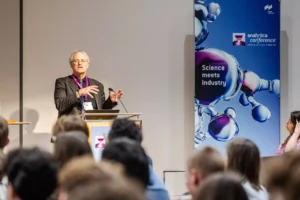
Carsten Roller, Ph.D., Head of Training at the Association for Biology, Biosciences and Biomedicine in Germany (VBIO). Image from Messe München GmbH press materials.
The fabled Analytica laboratory technology trade fair, long a staple in Europe and Asia, is finally making its U.S. debut, bringing a full slate of interactive demos and a two-day scientific program to Columbus, Ohio on September 10–12. “Half of the U.S. population can reach [Columbus] within two hours, and the ride from the airport to the venue is only 10 to 12 minutes,” said Susanne Grödl, exhibition director at Messe München, during an Aug. 28 press preview. The Analytica USA event marks the first U.S. edition of Messe München’s international lab trade fair at the Greater Columbus Convention Center with a two‑day scientific conference and an all‑day program of free demonstrations.
Columbus, by design
Karen Vogelsang, Analytica USA’s U.S. team lead, highlighted the advantages of Columbus as a venue for the laboratory technology trade fair on a press call. “The Convention Center is new, it’s modern, it’s clean, in a really nice area,” she said. And then there is the cost dimension. Columbus is considerably less expensive than East or West Coast hubs while also being a research hub in its own right. “OSU is there with huge research facilities,” Vogelsang said. “We have Abbott. We have Mettler Toledo. There is Ohio Life Sciences, which is huge in the life sciences industry. There’s a lot of infrastructure.”
The more research we do, the more we realize how the surrounding areas make it a really great location for Analytica USA. —Vogelsang
Why Ohio rather than Boston or San Diego? Grödl told reporters they chose Columbus for cost and access, and that success “isn’t guaranteed by being in Boston or San Diego.” In addition to the perks mentioned earlier, Vogelsang also praised the city’s hotels attached by skyways to the convention center, restaurants on High Street, and the North Market across the street. The venue itself markets being within a relatively short flight of the majority of the U.S. and once there, attendees will be within walking distance of dense amenities.
The event organizers are porting Analytica’s “three‑pillar” format to North America: a trade show, a science conference, and a practice‑oriented supporting program. The official program highlights Live Lab workflow demos, a Digital Transformation area focused on connected devices and robotics, and a Lab Safety Show. All are included with a visitor ticket and scheduled multiple times daily to avoid conflicts.
What to expect at Analytica USA
Analytica USA already appears to be resonating with exhibitors with the latest count hitting over 250 as shared during the August 28 press preview, surpassing initial projections and signaling strong industry buy-in. Among the heavy hitters, Messe München’s materials spotlight market leaders like Bruker, Mettler Toledo, PerkinElmer, Shimadzu and Thermo Fisher, many of whom are planning in-booth instrument briefings to showcase cutting-edge tools in chromatography, spectroscopy, and beyond. Other notable participants include Sartorius, HORIBA, KRÜSS, Specac, ACD/Labs, and FRITSCH, as per recent listings.
The German Pavilion is another focal point, with 19 companies participating as of August 28, backed by government support to bridge European and U.S. markets. This international flair extends to exhibitors from Europe and Asia, adding diversity to the show floor.
Attendance and success metrics
With the hall “almost fully booked” months ahead, organizers are optimistic about turnout. On the Aug. 28 call, Grödl said, “If we reach 2,500, it’s fine… our personal target is, for sure, 4,000.” For reference, Pittcon 2024 attracted about 6,000 attendees and about 470 exhibitors.
Event planners see Analytica USA as a biennial event with the next edition slated for 2027 in Columbus, per official press materials. Hall B at the Greater Columbus Convention Center, the event’s stated hall, offers approximately 118,000 sq. ft. of exhibit space.
Wrapping up what the event will offer, Grödl says it will encapsulate “the world of the laboratory at a glance,” spanning planning, sample preparation, detailed analysis, and quality control. “You can find all the devices and applications you need in the value chain for the laboratory,” she said. “Compared to the other U.S. shows, it’s a new and unique show concept.” She described the format as “three pillars: the show, a scientific conference, and a special supporting program,” intended to provide “knowledge transfer for all visitor groups, from CEOs to lab users.” As she put it, the aim is to be “the next meeting place for the entire lab industry.”