Research & Development World

  • R&D World Home
  • Topics
    • Aerospace
    • Automotive
    • Biotech
    • Careers
    • Chemistry
    • Environment
    • Energy
    • Life Science
    • Material Science
    • R&D Management
    • Physics
  • Technology
    • 3D Printing
    • A.I./Robotics
    • Software
    • Battery Technology
    • Controlled Environments
      • Cleanrooms
      • Graphene
      • Lasers
      • Regulations/Standards
      • Sensors
    • Imaging
    • Nanotechnology
    • Scientific Computing
      • Big Data
      • HPC/Supercomputing
      • Informatics
      • Security
    • Semiconductors
  • R&D Market Pulse
  • R&D 100
    • 2025 R&D 100 Award Winners
    • 2025 Professional Award Winners
    • 2025 Special Recognition Winners
    • R&D 100 Awards Event
    • R&D 100 Submissions
    • Winner Archive
  • Resources
    • Research Reports
    • Digital Issues
    • Educational Assets
    • R&D Index
    • Subscribe
    • Video
    • Webinars
    • Content submission guidelines for R&D World
  • Global Funding Forecast
  • Top Labs
  • Advertise
  • SUBSCRIBE

Molecular Oxygen in Comet’s Atmosphere Not Created on its Surface

By Imperial College London | July 3, 2018

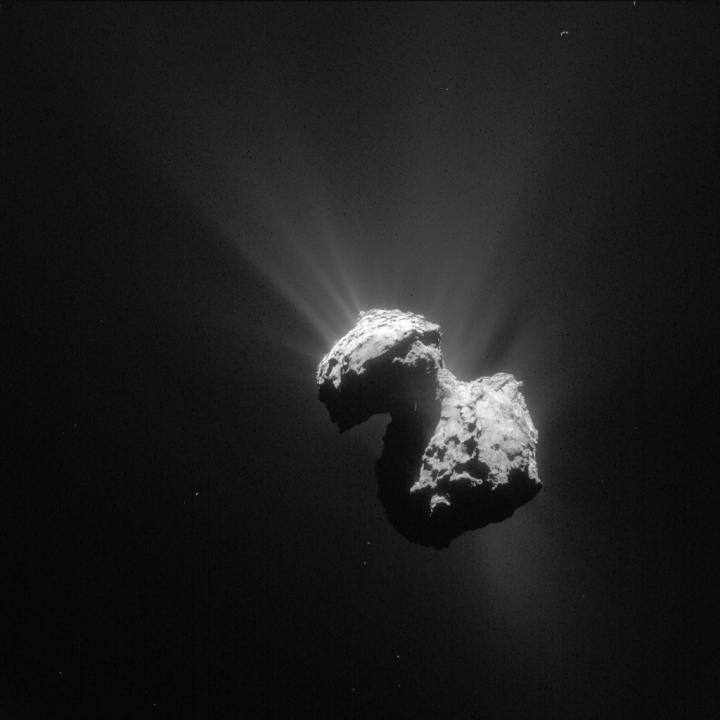
View of comet 67P taken by Rosetta. Credit: European Space Agency

Scientists have found that molecular oxygen around comet 67P is not produced on its surface, as some suggested, but may be from its body.

The European Space Agency’s Rosetta spacecraft escorted comet 67P/Churyumov-Gerasimenko on its journey round the sun from August 2014 – September 2016, dropping a probe and eventually crashing onto its surface.

When the comet is close enough to the sun the ice on its surface ‘sublimes’ – transforms from solid to gas – forming a gas atmosphere called a coma. Analysis of the coma by instruments on Rosetta revealed that it contained not only water, carbon monoxide and carbon dioxide, as anticipated, but also molecular oxygen.

Molecular oxygen is two oxygen atoms joined together, and on Earth it is essential for life, where it is produced by photosynthesis. It has been previously detected around some of the icy moons of Jupiter, but it was not expected to be found around a comet.

The Rosetta science team originally reported that the oxygen was most likely from the comet’s main body, or nucleus. This meant it was ‘primordial’ – that it was already present when the comet itself formed at the beginning of the Solar System 4.6 billion years ago.

One group of outside researchers however suggested there might be a different source for molecular oxygen at comets. They had discovered a new way to produce molecular oxygen in space triggered by energetic ions – electrically charged molecules. They proposed that reactions with energetic ions on the surface of comet 67P could instead be the source of the detected molecular oxygen.

Now, members of the Rosetta team have analysed the data on 67P’s oxygen in light of the new theory. In a paper published today in Nature Communications and led by Imperial College London physicists, they report that the proposed mechanism for producing oxygen on the surface of the comet is not sufficient to explain the observed levels in the coma.

Lead author Mr Kevin Heritier, from the Department of Physics at Imperial, said: “The first detection of molecular oxygen in 67P’s coma was both very surprising and exciting”.

“We tested the new theory of surface molecular oxygen production using observations of energetic ions, particles which trigger the surface processes which could lead to the production of molecular oxygen. We found that the amount of energetic ions present could not produce enough molecular oxygen to account for the amount of molecular oxygen observed in the coma.”

Co-author Dr Marina Galand, from the Department of Physics at Imperial and Science Co-Investigator of the Rosetta Plasma Consortium, added: “Surface generation of molecular oxygen may still happen on 67P, but the majority of the molecular oxygen in the coma is not produced through such a process.”

The new analysis is consistent with team’s original conclusion, that molecular oxygen is most likely primordial. Other theories have been proposed, and can’t yet be ruled out, but the primordial theory currently fits the data best.

This is also supported by recent theories which revisited the formation of the molecular oxygen in dark clouds and the presence of molecular oxygen in the early Solar System. In this model, molecular oxygen created froze onto small dust grains. These grains collected more material, eventually building up the comet and locking the oxygen in the nucleus.
Related Articles Read More >

The Milky Way is glowing: these scientists think dark matter may be the cause
Reusable rocket startup raises $510 million
2025 R&D layoffs tracker: hardware and chips lead the year’s biggest cuts while biopharma pares pipelines
Sonar Screen For Submarines And Ships. Radar Sonar With Object On Map. Futuristic HUD Navigation monitor
Pentagon places big bets on frontier AI, quantum sensing and next-gen avionics in nearly $3 billion in defense technology contracts 
rd newsletter
EXPAND YOUR KNOWLEDGE AND STAY CONNECTED
Get the latest info on technologies, trends, and strategies in Research & Development.
RD 25 Power Index

R&D World Digital Issues

Fall 2024 issue

Browse the most current issue of R&D World and back issues in an easy to use high quality format. Clip, share and download with the leading R&D magazine today.

Research & Development World
  • Subscribe to R&D World Magazine
  • Sign up for R&D World’s newsletter
  • Contact Us
  • About Us
  • Drug Discovery & Development
  • Pharmaceutical Processing
  • Global Funding Forecast

Copyright © 2025 WTWH Media LLC. All Rights Reserved. The material on this site may not be reproduced, distributed, transmitted, cached or otherwise used, except with the prior written permission of WTWH Media
Privacy Policy | Advertising | About Us

Search R&D World

  • R&D World Home
  • Topics
    • Aerospace
    • Automotive
    • Biotech
    • Careers
    • Chemistry
    • Environment
    • Energy
    • Life Science
    • Material Science
    • R&D Management
    • Physics
  • Technology
    • 3D Printing
    • A.I./Robotics
    • Software
    • Battery Technology
    • Controlled Environments
      • Cleanrooms
      • Graphene
      • Lasers
      • Regulations/Standards
      • Sensors
    • Imaging
    • Nanotechnology
    • Scientific Computing
      • Big Data
      • HPC/Supercomputing
      • Informatics
      • Security
    • Semiconductors
  • R&D Market Pulse
  • R&D 100
    • 2025 R&D 100 Award Winners
    • 2025 Professional Award Winners
    • 2025 Special Recognition Winners
    • R&D 100 Awards Event
    • R&D 100 Submissions
    • Winner Archive
  • Resources
    • Research Reports
    • Digital Issues
    • Educational Assets
    • R&D Index
    • Subscribe
    • Video
    • Webinars
    • Content submission guidelines for R&D World
  • Global Funding Forecast
  • Top Labs
  • Advertise
  • SUBSCRIBE