[Image courtesy of NASA]
For instance, a 2020 NASA Aerospace Safety Advisory Panel report warned that “due to some fundamental [Systems Engineering and Integration] missteps” during earlier test flights, Starliner “not only did not meet the mission objectives, but it could have resulted in the loss of the vehicle.” The panel noted that Starliner “encountered several software-driven problems that threatened its operation,” resulting in 80 corrective actions.
Cascading failures threaten docking
As the Starliner, carrying Wilmore and Williams, approached the ISS on June 6, 2024, the mission took a dangerous turn. Initially, two aft-facing reaction control system (RCS) thrusters failed. This immediately put the crew in a challenging position, just one additional failure away from losing six-degrees-of-freedom (6DOF) control — the ability to maneuver in any direction. Standard flight rules dictated an abort under such conditions. Yet the situation rapidly deteriorated as a third, then a fourth thruster failed, severely impairing attitude control and eliminating the spacecraft’s ability to translate forward.
Starliner issues highlighted in ASAP 2020 report
Key findings regarding Boeing Starliner from the NASA Aerospace Safety Advisory Panel’s 2020 Annual Report:
The 2020 ASAP report highlighted several concerns following Boeing’s first Starliner Orbital Flight Test (OFT-1) in December 2019. The panel noted critical issues with “validation and verification of the flight software.” It concluded that “Due to some fundamental SE&I [Systems Engineering & Integration] missteps, the OFT flight test not only did not meet the mission objectives, but it could have resulted in the loss of the vehicle.” The test encountered multiple software-driven problems and command link outages that threatened the spacecraft.
A major concern arising from the OFT-1 anomaly was the panel’s finding that “there is no single test facility that can perform end-to-end, integrated avionics and software integration and testing.” This lack of comprehensive integrated testing capability was seen as a vulnerability. The report stressed that the “Boeing OFT anomaly highlighted the potential for similar escapes to pose significant risks to other programs.”
In response to the OFT-1 issues, NASA and Boeing formed a Joint Independent Review Team (JIRT), and the Starliner Program worked closely with them to address numerous recommendations. The panel viewed the mishap as having “offered additional opportunity for NASA to hone its oversight of SE&I principles.” At the time of the report (late 2020), Boeing was proceeding with corrective actions and preparing for a second OFT, with NASA and Boeing “fully engaged in building up to a retest and solving these issues” ahead of expected certification.
Wilmore recounted his immediate concerns about the vehicle’s viability, believing a safe return to Earth might also be impossible: “I don’t know that we can come back to Earth at that point.” Faced with this dilemma – unable to safely dock or potentially return – NASA’s mission control made the critical decision to waive standard flight rules and attempt a remote recovery. Controllers in Houston instructed Wilmore to momentarily release manual control, announcing “hands off” before implementing a solution: remotely commanding resets of the thruster system. After two resets, enough thrusters recovered function to regain partial 6DOF control, enabling a successful, if tense, docking despite the compromised system.
A pattern of propulsion and verification headaches
This near-disaster occurred despite years of development and data from a previous uncrewed flight (OFT-2) in May 2022, which also experienced thruster anomalies, including failures during orbital insertion and docking approach. Furthermore, the CFT mission was plagued by five separate helium leaks discovered in Starliner’s service module propulsion system – one known before launch and four developing in flight – raising concerns about maintaining propellant pressure.
Post-flight analysis of the CFT thruster failures traced the immediate problem to overheating of small Teflon seal components (“poppets”) within the thruster valves. Engineers believe repeated firing commands, particularly under manual control in direct sunlight, caused seals to deform and restrict propellant flow. While ground tests showed the seals could recover shape when cooled, this thermal vulnerability wasn’t adequately addressed during design and qualification.
Systemic gaps in R&D processes
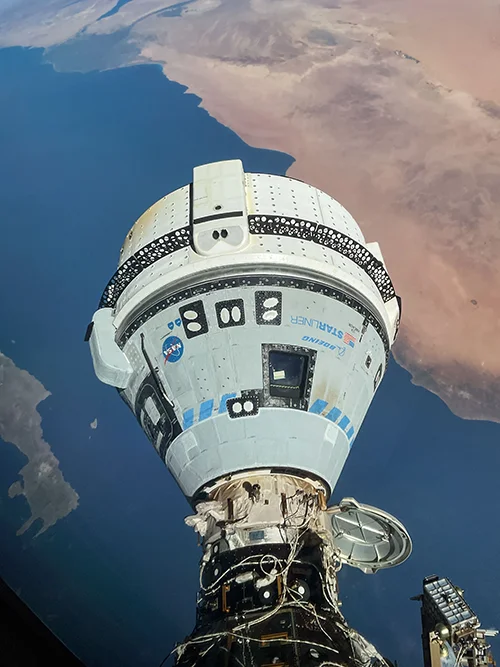
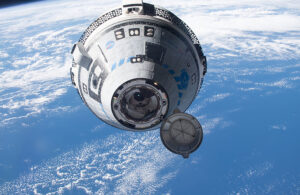
[Starliner image courtesy of NASA]
Troubles continued. The planned OFT-2 launch in August 2021 was scrubbed owing to corroded oxidizer valves caused by unexpected moisture reacting with propellant — a flaw requiring a major redesign. Even in 2023, late-stage reviews uncovered flagging strength margins in parachute system components and fire risks from flammable tape on wiring harnesses, requiring laborious remediation. NASA had earlier identified “numerous process escapes” and noted that “breakdowns in the test and verification phase failed to identify… defects preflight.” The June 2024 incidents suggest these systemic weaknesses may persist.
Stranded astronauts
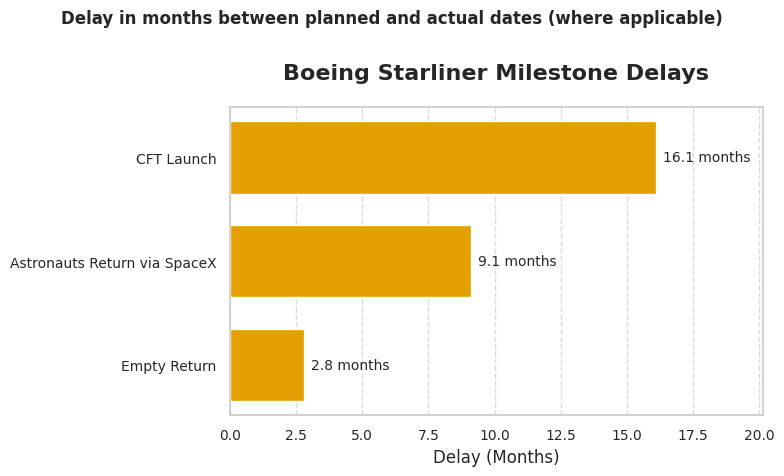
The combination of thruster unreliability and helium leaks during the CFT mission created so much uncertainty that NASA ultimately deemed the spacecraft too risky for the crew’s return journey. After weeks of analysis while Wilmore and Williams remained aboard the ISS, NASA decided in late summer 2024 that Starliner would return to Earth empty. The uncrewed capsule successfully landed at White Sands, New Mexico, on September 6.
Wilmore and Williams saw their planned eight-day mission turn into a nearly nine-month extended stay. They eventually returned to Earth not aboard Starliner, but via a SpaceX Crew Dragon spacecraft (Crew-9) on March 18, 2025. This marked the first time NASA astronauts launched on one type of American vehicle and returned on another.
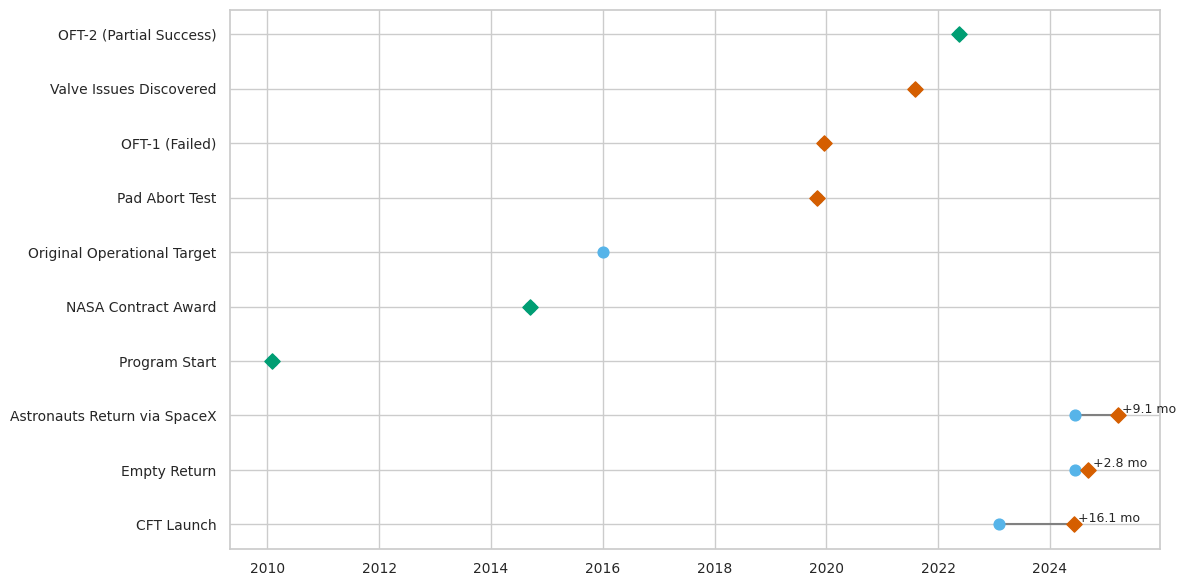
A summary of Starliner problems and developments based on public data
Root cause analysis and next steps
NASA and Boeing are now engaged in an root cause investigation, analyzing data, inspecting hardware, and reviewing design, testing, and operations. Identifying and demonstrably fixing the root causes of the thruster failures and helium leaks is critical before Starliner can be certified for regular crew missions. This could potentially involve hardware redesigns, updated materials, modified procedures, or potentially another uncrewed test flight.
The stakes are significant. Boeing has absorbed over $2 billion in cost overruns on its fixed-price Commercial Crew contract. Further delays or redesigns will add to this burden and impact the company’s reputation. For NASA, getting Starliner operational is crucial for redundant US crew access to the ISS. To date, perhaps the key R&D takeaways from Starliner’s journey is a reminder: complex system development demands relentless scrutiny and validation processes that accurately mirror the unforgiving reality of spaceflight.