Research & Development World

  • R&D World Home
  • Topics
    • Aerospace
    • Automotive
    • Biotech
    • Careers
    • Chemistry
    • Environment
    • Energy
    • Life Science
    • Material Science
    • R&D Management
    • Physics
  • Technology
    • 3D Printing
    • A.I./Robotics
    • Software
    • Battery Technology
    • Controlled Environments
      • Cleanrooms
      • Graphene
      • Lasers
      • Regulations/Standards
      • Sensors
    • Imaging
    • Nanotechnology
    • Scientific Computing
      • Big Data
      • HPC/Supercomputing
      • Informatics
      • Security
    • Semiconductors
  • R&D Market Pulse
  • R&D 100
    • 2025 R&D 100 Award Winners
    • 2025 Professional Award Winners
    • 2025 Special Recognition Winners
    • R&D 100 Awards Event
    • R&D 100 Submissions
    • Winner Archive
  • Resources
    • Research Reports
    • Digital Issues
    • Educational Assets
    • R&D Index
    • Subscribe
    • Video
    • Webinars
    • Content submission guidelines for R&D World
  • Global Funding Forecast
  • Top Labs
  • Advertise
  • SUBSCRIBE

The View From Inside Supersonic Combustion

By American Institute of Physics | March 15, 2018

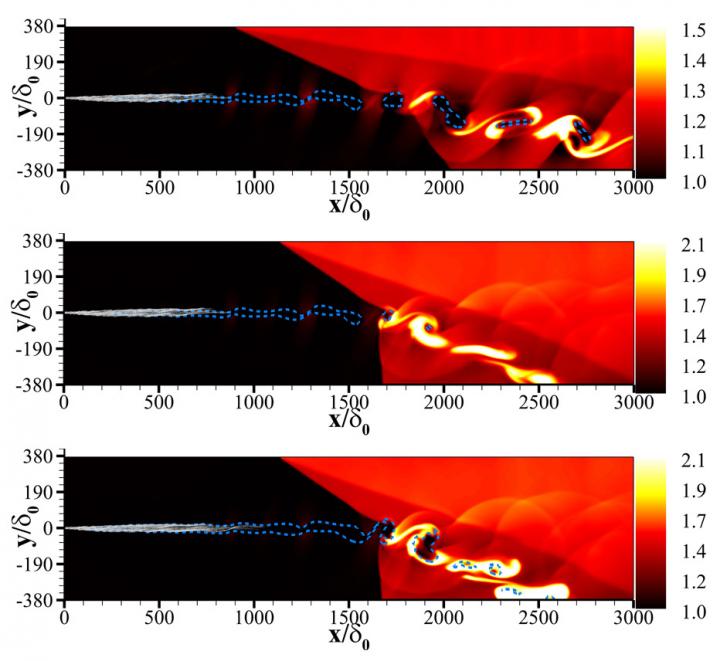
Instantaneous distributions of dimensionless temperature T/T0 and fuel mass fraction, with blue dashed lines given by YF=0.05: (top, Case LP-OS1) weak shock with stoichiometric mixture, (middle, Case LP-OS2) strong shock with stoichiometric mixture, and (bottom, Case LP-OS2-H) strong shock with fuel-rich mixture. Here, the gray dots indicate evaporating fuel droplets.

In a jet engine, the flow of air is slowed down to increase the temperature and pressure for combustion — burning fuel with the right ratio of fuel and air to conquer drag allows for acceleration.

But in supersonic engines achieving the right flow speed, producing the right ratio of evaporated fuel and causing ignition at the right time is more complex. With evaporating liquid in a combustion chamber, there is more at play than just gravity and drag, especially with supersonic shock waves in the equation.

Vortices — the dynamic structures created in a turbulent flow –are affected by the shock wave. This changes the way the fuel combusts and multiplies the number of possibilities of how particles can behave. To deepen our understanding of the dynamics of supersonic flow, researchers look to numerical modeling to calculate the huge variety of possible outcomes in this changed system.

In their study, published this week in Physics of Fluids, by AIP Publishing, Zhaoxin Ren, Bing Wang and Longxi Zheng viewed supersonic combustion in a time series through numerical modeling. This allowed them to see how changing variables, such as mass loading fuel, the intensity of the shock wave, and the types of reflecting and transmitted waves created at different points in time will affect ignition.

They were able to quantitatively characterize the influence of an incident oblique shock wave on large-scale shearing vortices and exothermal reactions, mathematically mapping the influence of variables and the resulting types of waves created in a shocked gas. Their analysis establishes a reliable simulation method for supersonic combustion using mathematical modeling tools specifically designed for this purpose.

“Currently, no commercial software can simulate the supersonic combustion problem because it requires high-order numerical schemes to compute supersonic flows with complicated evolved shocks, as well as corrected models to describe the droplet dynamics, both of which we carefully consider in our in-house simulation codes,” Wang said, a co-author of the study. “Direct numerical simulation can capture the full scales of flows involved in the shock-vortex interaction.”

Using a combination of custom simulation codes and the Eulerian-Lagrangian method commonly applied to particle-laden two-phase flows, the authors were able to run a broad range of simulations and provide a series of test cases that inform scramjet engine design. Their analysis revealed two induced combustion modes, including a local quasi detonation mode that occurs due to the formation of a refracted wave coupled with the chemical reaction.

“The scramjet engine is the most favorable option for high-speed flight at Mach six or more,” Wang said. “Understanding the complicated physical mechanism of supersonic combustion and the impact of incident shock waves could help engineers choose the best combination of mixing and combustion through installing movable components in the combustor.”


Related Articles Read More >

Researchers could be one step closer to understanding the origin of matter thanks to a new study
The Milky Way is glowing: these scientists think dark matter may be the cause
Three scientists awarded Nobel Prize in physics for showing quantum properties could exist in large-scale systems
ORNL named on 20 R&D 100 Awards, including carbon-capture and AM tools
rd newsletter
EXPAND YOUR KNOWLEDGE AND STAY CONNECTED
Get the latest info on technologies, trends, and strategies in Research & Development.
RD 25 Power Index

R&D World Digital Issues

Fall 2025 issue

Browse the most current issue of R&D World and back issues in an easy to use high quality format. Clip, share and download with the leading R&D magazine today.

Research & Development World
  • Subscribe to R&D World Magazine
  • Sign up for R&D World’s newsletter
  • Contact Us
  • About Us
  • Drug Discovery & Development
  • Pharmaceutical Processing
  • Global Funding Forecast

Copyright © 2025 WTWH Media LLC. All Rights Reserved. The material on this site may not be reproduced, distributed, transmitted, cached or otherwise used, except with the prior written permission of WTWH Media
Privacy Policy | Advertising | About Us

Search R&D World

  • R&D World Home
  • Topics
    • Aerospace
    • Automotive
    • Biotech
    • Careers
    • Chemistry
    • Environment
    • Energy
    • Life Science
    • Material Science
    • R&D Management
    • Physics
  • Technology
    • 3D Printing
    • A.I./Robotics
    • Software
    • Battery Technology
    • Controlled Environments
      • Cleanrooms
      • Graphene
      • Lasers
      • Regulations/Standards
      • Sensors
    • Imaging
    • Nanotechnology
    • Scientific Computing
      • Big Data
      • HPC/Supercomputing
      • Informatics
      • Security
    • Semiconductors
  • R&D Market Pulse
  • R&D 100
    • 2025 R&D 100 Award Winners
    • 2025 Professional Award Winners
    • 2025 Special Recognition Winners
    • R&D 100 Awards Event
    • R&D 100 Submissions
    • Winner Archive
  • Resources
    • Research Reports
    • Digital Issues
    • Educational Assets
    • R&D Index
    • Subscribe
    • Video
    • Webinars
    • Content submission guidelines for R&D World
  • Global Funding Forecast
  • Top Labs
  • Advertise
  • SUBSCRIBE