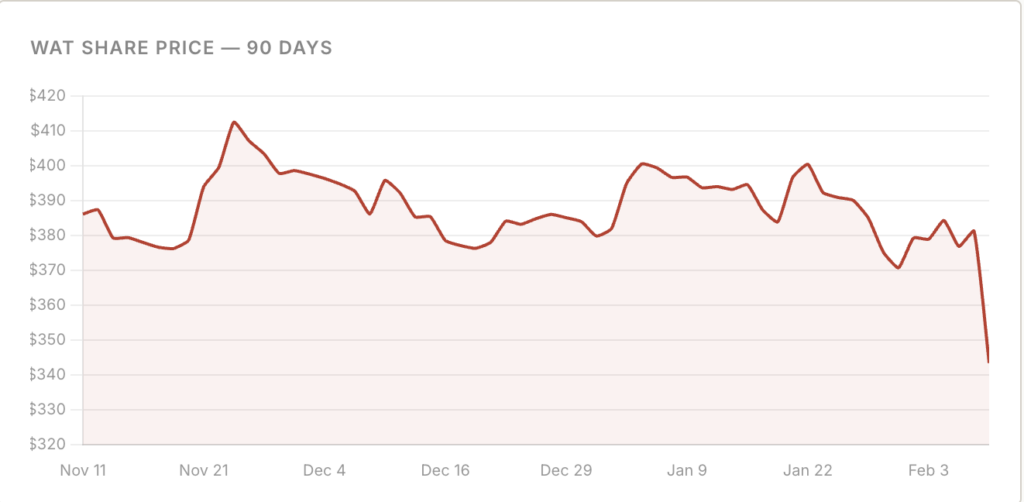
 Waters Corp. (NYSE: WAT) completed its roughly $18.8 billion combination with BD’s Biosciences & Diagnostic Solutions businesses on Feb. 9, 2026—and promptly watched its stock fall as much as 12% intraday to $335.86, recovering slightly to around $343 by midday.
The selloff wasn’t about the deal structure or the standalone Waters results, both of which were solid. It was about what CEO Udit Batra disclosed on the morning earnings call: the business Waters just acquired showed up weaker than expected in Q4, and the company is guiding to a low-single-digit revenue decline for the BD assets in Q1 2026.
The standalone Waters business beat estimates and delivered 7% full-year growth. But the $18.8B asset it just absorbed is declining in Q1, and CEO Batra is reaching for the turnaround playbook.
Waters Corp. (NYSE: WAT) completed its roughly $18.8 billion combination with BD’s Biosciences & Diagnostic Solutions businesses today, 2026, and promptly watched its stock fall as much as 12% intraday to $335.86, recovering slightly to around $343 by midday.
The selloff centered around what CEO Udit Batra disclosed on the morning earnings call: the business Waters just acquired showed up weaker than expected in Q4, and the company is guiding to a low-single-digit revenue decline for the BD assets in Q1 2026.
What happened to the BD business
 CFO Amol Chaubal detailed four headwinds that converged in Q4, “a couple of which sort of crept in” beyond what was anticipated in Q3:
First, weakened demand tied to China’s drug regulatory group (DRG) reforms. Second, a higher prior-year baseline inflated by one-time intellectual property revenue. Third, a mild flu season that slowed point-of-care testing volumes. And fourth, delayed export approvals to China caused by the U.S. federal government shutdown.
Chaubal argued three of the four are already lapping out of the baseline by Q1, with the DRG headwind the exception, which won’t fully anniversary until late Q3. He projected the BD business would return to growth over the course of 2026, but the starting point is negative.
Several issues emerged in Q4 that impacted the growth of both of those businesses that were not fully known in Q3… This reminds me of Waters almost five years ago. — Udit Batra, President & CEO, Waters Corporation
Batra drew a it parallel to his early days at Waters, when he implemented a centralized pricing discipline and commercial execution framework that eventually drove the company’s service-plan attachment from 43% to 54% and eCommerce chemistry adoption from 20% to 45% over five years.
He outlined a three-part plan for the BD assets: implementing a deal desk for pricing and discounting discipline (with escalation authority running up to him personally), ensuring launch readiness for new products including the FACSDiscover S8, A8, S7 and A7 lines, and deploying the instrument replacement, eCommerce, and service-attachment synergy levers the company had detailed in its investor materials.
On the reagent and dye pricing specifically, Batra was blunt: “These are highly differentiated dyes and antibodies that only BD produces, and these are of the highest quality. There is zero reason why there should be discounting there.”
The standalone story was fine
Stripped from the BD noise, legacy Waters delivered a clean quarter. Q4 revenue of $932M topped the $928.7M consensus, non-GAAP EPS of $4.53 beat the $4.51 estimate, and full-year revenue of $3.165B grew 7% in constant currency with 11% EPS growth. LC-MS instruments grew at high-single-digit rates in every quarter of 2025, chemistry consumables grew 12% for the year, and the company’s idiosyncratic growth drivers: GLP-1s (+$32M), PFAS testing (+$23M), and Indian generics (+$40M). All told, those drivers collectively added over 300 basis points of incremental growth.
For fiscal 2026, Waters guided to total reported revenue of $6.405–6.455B, including roughly $3B from the acquired businesses and $50M in first-year revenue synergies. Non-GAAP EPS guidance of $14.30–14.50 implies roughly 9–10% growth. Organic constant-currency growth is projected at 5.5–7%, with Q1 expected to be the strongest quarter at 7–9%.
What analysts were asking
On the call, Jefferies’ Tycho Peterson went straight at the BD deterioration and the Empower subscription transition’s circa 250 bps instrument headwind. Baird’s Katherine Schulte pressed on implied deceleration after a strong Q1 guide. Wolfe’s Doug Schenkel asked whether cost synergies were already running ahead of the deal model (Batra noted their underwriting assumed ~4–4.5% of the combined cost base, below the 6% typical for deals of this size and well below the 8% he achieved at MilliporeSigma).
JP Morgan’s Casey Woodring asked about chemistry pricing, drawing out Batra’s comment on 100–200 bps of pricing improvement with high stick rates in the consumables business.