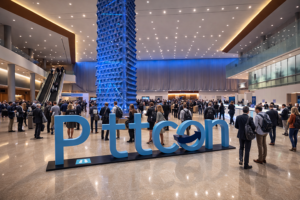
 Pittcon 2026 drew more than 300 exhibitors to San Antonio’s Henry B. González Convention Center displaying a mix of instruments, sample-prep systems and lab software. On the instrument side, vendors emphasized speed, usability and fit for specialized testing environments. TA Instruments (a Waters brand) launched the ARES-G3 rheometer at the show, claiming 25,000 data points per second and up to 80% faster standard tests. Applied Rigaku debuted the NEX QC II benchtop XRF as a compact, no-PC, touchscreen-operated QC platform. Meanwhile, Shimadzu spotlighted the TOC-1000e S for semiconductor ultrapure-water monitoring alongside six other new or updated products, the broadest single-vendor showing at the conference. Xylaem showcased the MultiLab Pro IDS, a four-channel benchtop meter built around its digital sensor ecosystem.
Elsewhere on the floor, vendors pushed workflow-focused systems aimed at reducing labor and speeding routine analysis. Biotage highlighted PrepXpert-8, an automated sample-prep platform for high-throughput SVOC and PFAS workflows.
Velaris made its Pittcon debut as a Battery Ventures-backed consolidation of seven lab automation companies: GERSTEL, Skalar, Markes International and four others. Several LIMS vendors staked out competing visions: LabVantage launched CORTEX with autonomous AI agents, LabWare pitched its ASSURE SaaS LIMS with a claimed deployment time of under 30 days, and Confience (an exhibitor formed from the merger of ATL and QSI, targeting food, water and manufacturing labs) pushed config-not-code for non-pharma environments.
The seven trends below focus on the patterns behind launches like these: faster workflows, more automation, tighter fit with regulated and industrial use cases, and a stronger push to tie product claims to specific lab bottlenecks.
1. A two-speed equipment market
One theme that emerged in conversations at Pittcon is that some sectors are spending much more confidently than others. While the biopharma sector itself is bifurcated, pharma and biopharma budgets are loosening for equipment. “Pharma still has the budgets,” one instrument company representative said on the show floor. Small R&D service labs, universities and government labs are more resource constrained. In one mid-year 2025 survey of labs affected by NIH-related grant disruptions, 51% reported capital budget cuts of more than 10%. While the situation has stabilized to a degree since, budgets for new lab equipment remain tight for many government labs.
The food industry, too, remains cautious. A CRB survey cited by Food Processing found that 51% of food and beverage manufacturers had reduced their annual capital spending budgets for 2025. Food and beverage companies are “rarely early adopters,” said one exhibitor.
2. Instruments becoming more modular and, at times, leaving the lab
A consistent thread across the expo floor was modularity and simplification: analytical tools designed for increasingly smaller footprints, less specialized operators and use cases closer to where decisions get made. Applied Rigaku’s NEX QC II benchtop XRF, for instance, requires no external PC, includes a built-in printer, and is aimed at production-floor elemental analysis rather than a spectroscopist’s bench. Anton Paar’s new MCR 53, 73 and 93 rheometers add guided QC workflows and integrated touchscreens meant to reduce operator dependence. Shimadzu’s Nexera UC Prep, a preparative supercritical fluid chromatography system, was positioned as a compact platform designed to fit existing workflows.
That same push showed up in how vendors talked about training. JEOL’s benchtop SEM, which a company marketer called his favorite product to promote because of its broad addressable market, can bring users to functional competency in two days. “People don’t need to know the exact path the electrons take,” the vendor said. “They need to know what those numbers do to their image.”
Other exhibitors pushed the concept further toward true field or distributed deployment. Axcend’s shoebox-sized Focus LC brings high-pressure liquid chromatography into a compact format that can be used well outside a traditional instrument room. DetectaChem pitched handheld Raman and trace detection as a field assessment kit. EN-SCAN brought lab-grade GC into the field for real-time VOC and fenceline monitoring.
3. Battery materials are pulling instrument companies into new categories
When an analytical instrument company enters an entirely new product category, that’s a market signal. Anton Paar, known for density meters and rheometers, used Pittcon to showcase its Julia DSC series, a differential scanning calorimeter that reaches -35°C on Peltier air cooling alone. Booth reps said demand was strongest in battery materials, especially membrane and solid-state electrolyte characterization. Meanwhile, a PerkinElmer ICP-MS specialist working the Pacific Northwest said he saw strong demand from labs focused on sodium batteries (using desalination brine as feedstock), copper foam batteries, and magnesium batteries driving new analytical requirements. PerkinElmer’s go-to-market model puts PhD specialists on every product line, no generalists.
4. Sustainability hits consumables
Sustainability showed up at Pittcon, working its way into products, workflows and purchasing decisions. The pitches were about reducing waste, solvent use and operating cost without asking labs to sacrifice performance or reliability.
MilliporeSigma had bio-based HPLC solvents in the booth conversation, pitching ethanol-based alternatives as easier to purify than petroleum-based acetonitrile because you avoid the organic contaminant residue that comes with petroleum feedstock. Other exhibitors pushed sustainability as well. Grenova’s pitch around pipette-tip washing and reuse targets one of the most visible streams of single-use plastic waste. Waters’ new 1 mm microflow LC columns also cut sample consumption by 75% and reduce solvent use by fourfold or more. Sustainability gains traction fastest when it arrives disguised as throughput, lower operating cost, or both.
5. Lab informatics continues to gain momentum
LIMS vendors were unusually visible at Pittcon. LabWare, Confience and LabVantage all used the show as a stage, with at least LabVantage pairing its presence with a major launch. The category is moving beyond plumbing toward orchestration.
Regarding LabVantage’s CORTEX mentioned earlier, the platform positions autonomous AI agents for sample management and compliance monitoring on a cloud-native platform. In some cases, AI that can act rather than just assist. LabWare showcased how its ASSURE SaaS LIMS can get a food safety lab running in under 30 days. “You can build a better mousetrap, but if people can’t adopt it because they can’t afford it or it’s too disruptive to their business, it doesn’t matter,” said John Newtown, a LabWare national account manager. The company framed the go-live process as three stages: learn, load, live. Human-led coaching helps guide the onboarding.
The framing of AI agents at the show tended toward tackling tedium rather than aggressive automation. “Our customers don’t want agents that run the lab on their own,” one LIMS startup representative said. “They want assistants that handle the rote work so people can focus on science.” LabVantage built a full agentic platform on AWS Agent Core with configurable human-in-the-loop checkpoints based on risk: low-risk tasks like reordering pipette tips run autonomously, while precision therapy workflows get multiple checks.
6. Compliance and business logic are being built into architecture
Across LIMS vendors, instrument makers and meter companies, compliance is being designed into the product architecture rather than layered on after deployment. Xylem’s new MultiLab Pro IDS meter builds audit trails, user management and 21 CFR Part 11 workflows directly into the instrument. “Labs are being asked to do more, more parameters, more data, more compliance, and they’re being asked to do that with less experience, less space and less budget,” said Michelle Kuzio, product manager for Xylem Laboratory Solutions in North America. “These pressures are not temporary.”
LIMS vendor Labbit maps lab workflows using Business Process Model and Notation borrowed from the business world, then stores each workflow step as a node in a knowledge graph that doubles as the electronic record for FDA compliance. Another routes every AI agent interaction through a third-party evaluation platform that audits prompts and validates responses in real time.
Pre-validated SaaS deployments, sensor-level calibration histories and agent-level audit trails are all expressions of the same idea.
7. AI as analytical colleague
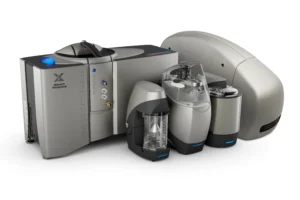
Malvern Panalytical launches Mastersizer 3000+
The self-driving lab was the most-discussed concept in the conference sessions. Monday’s programming featured presentations from Genentech, Takeda, Merck and GSK describing production-level autonomous workflows.
On the expo floor, AI showed up in two registers. The vendor-led version: LabVantage CORTEX’s agentic AI, CEM’s MARSXpress 2.0 with AI-integrated digestion, Malvern Panalytical (pictured) embedding AI into the Mastersizer 3000+ for method development. The more interesting register was infrastructure: Rigaku’s LabLinc Studio framing instrument orchestration as a digital twin, Velaris positioning sample-prep-to-result as a single automated pipeline. One LIMS vendor described abandoning RAG entirely in favor of context engineering, uploading SOPs to MCP servers that agents query on demand rather than stuffing context windows. Another trained an agent on a retiring colleague’s 400,000 emails and training videos to create a “virtual twin” that can field customer questions with that person’s institutional knowledge.
Pittcon 2026 ran March 7-11, 2026 at the Henry B. González Convention Center in San Antonio, Texas, under the theme “The Scientific Frontier.” Nobel laureate Frances Arnold delivered the Coulter Keynote Lecture. The expo floor was open March 9-11.