
The next time you set a kettle to boil, consider this scenario: After turning the burner off, instead of staying hot and slowly warming the surrounding kitchen and stove, the kettle quickly cools to room temperature and its heat hurtles away in the form of a boiling-hot wave. We know heat doesn’t behave this way…
Super Clean Spaces Could be Driving Up Antimicrobial Resistance

Hidden Leukemic Stem Cells Isolated by Genetically Encoded Sensor
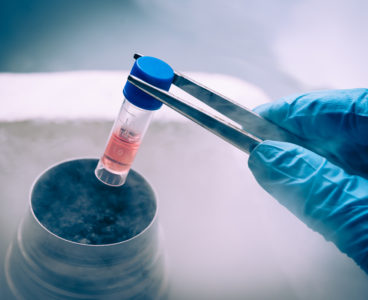
All stem cells can multiply, proliferate and differentiate. Because of these qualities, leukemic stem cells are the most malignant of all leukemic cells. Understanding how leukemic stem cells are regulated has become an important area of cancer research. A team of Tel Aviv University researchers have now devised a novel biosensor that can isolate and…
Cleanroom Snapshot: Cheops in the Cleanroom
The copper-colored baffle cover of the European Space Agency’s Characterising Exoplanet Satellite, Cheops, in the cleanroom at Airbus Defence and Space Spain, Madrid. After completing spacecraft testing, the satellite has passed a very important review that determined it is ready to fly. Cheops will be stored in Madrid for a few months before being shipped…
Superlattice Patterns Change Electronic Properties of Graphene
Combining an atomically thin graphene and a boron nitride layer at a slightly rotated angle changes their electrical properties. Physicists at the University of Basel have now shown for the first time the combination with a third layer can result in new material properties also in a three-layer sandwich of carbon and boron nitride. This…
Light-shaking Device is a Breakthrough for Photonics
Graphene and Cobalt Used to Create New Electromagnetic Devices

Researchers from IMDEA Nanociencia and other European centers have discovered that the combination of graphene with cobalt offers relevant properties in the field of magnetism. This breakthrough sets the stage for the development of new logic devices that can store large data amounts quickly and with reduced energy consumption. One of the latest technologies for…
Space Radiation Detector Investigates Fake Masterpieces
Technology originally developed for CERN’s Large Hadron Collider and then flown in space by ESA is now being used to analyze historic artworks, helping to detect forgeries. “The art market is a jungle—some say that around 50 percent of art pieces and paintings are either fakes or are incorrectly attributed,” explains Josef Uher, chief technology…
Lasers Tweeze and Pole Protein Droplets
University at Buffalo physicists are using innovative tools to study the properties of a bizarre class of molecules that may play a role in disease: proteins that cluster together to form spherical droplets inside human cells. The scientists’ latest research sheds light on the conditions that drive such droplets to switch from a fluid, liquidy…
Mini Magnetic Sensors Could Operate Without Power Supply
Scientists of the Department of Physics at the University of Hamburg, Germany, detected the magnetic states of atoms on a surface using only heat. The respective study is published in a recent volume of Science. A magnetic needle heated by a laser beam was placed in close proximity to a magnetic surface with a gap…
Graphene-based Device Paves the Way for Ultrasensitive Biosensors
Researchers in the University of Minnesota College of Science and Engineering have developed a unique new device using the wonder material graphene that provides the first step toward ultrasensitive biosensors to detect diseases at the molecular level with near perfect efficiency. Ultrasensitive biosensors for probing protein structures could greatly improve the depth of diagnosis for…
Laser Measurement Technique Could Revolutionize Fiber-optic Communications
A team of researchers from the University of St Andrews has achieved a breakthrough in the measurement of lasers which could revolutionize the future of fiber-optic communications. The new research, published in Optics Letters, reveals the team of scientists has developed a low-cost and highly-sensitive device capable of measuring the wavelength of light with unprecedented…
Smoothing Out Graphene’s Wrinkles

To protect graphene from performance-impairing wrinkles and contaminants that mar its surface during device fabrication, MIT researchers have turned to an everyday material: wax. Graphene is an atom-thin material that holds promise for making next-generation electronics. Researchers are exploring possibilities for using the exotic material in circuits for flexible electronics and quantum computers, and in…
Lasers and Shellfish Reveal Clues into Ancient Climate
Shellfish played a significant role in the diet of prehistoric coastal populations, providing valuable nutrients. They are a common find in archaeological sites all over the world, usually in huge numbers, and researchers have long explored how they could be used to make inferences about the environments that humans experienced at those locations in the…
Graphene Quantum Dots for Single Electron Transistors
Scientists from the Higher School of Economics, Manchester University, the Ulsan National Institute of Science & Technology and the Korea Institute of Science and Technology have developed a novel technology, which combines the fabrication procedures of planar and vertical heterostructures in order to assemble graphene-based single-electron transistors of excellent quality. This technology could considerably expand…
New Laser Beam Shape Can ‘Sneak’ through Opaque Media
Researchers have found a way to pre-treat a laser beam so that it enters opaque surfaces without dispersing—like a headlight that’s able to cut through heavy fog at full strength. The discovery from scientists at Yale University and the Missouri University of Science & Technology has potential applications for deep-tissue imaging and optogenetics, in which…
Scientists Construct Anti-laser Based on Random Scattering
The laser is the perfect light source: As long as it is provided with energy, it generates light of a specific, well-defined color. However, it is also possible to create the opposite – an object that perfectly absorbs light of a particular color and dissipates the energy almost completely. At TU Wien (Vienna), a method…
Researchers Produce First Scalable Graphene Yarns for Wearable Textiles
Researchers Craft First Supersymmetric Laser Array
A team of University of Central Florida researchers has overcome a long-standing problem in laser science, and the findings could have applications in surgery, drilling and 3D laser mapping. Using the principle of supersymmetry, they have developed the first supersymmetric laser array. Their findings were published recently in the journal Science. Supersymmetry is a conjecture…
Revolutionary Wireless Sensors Gently Monitor NICU Babies

An interdisciplinary Northwestern University team has developed a pair of soft, flexible wireless body sensors that replace the tangle of wire-based sensors that currently monitor babies in hospitals’ neonatal intensive care units (NICU) and pose a barrier to parent-baby cuddling and physical bonding. The team recently completed a collection of first human studies on premature…
Hall Effect Turns Viscous in Graphene

Researchers at The University of Manchester have discovered that the Hall effect—a phenomenon well known for more than a century—is no longer as universal as it was thought to be. In the research paper published in Science, the group led by Prof Sir Andre Geim and Dr. Denis Bandurin, found that the Hall effect can…
Graphite Reveals a Quantum Surprise
Researchers at The University of Manchester have discovered unexpected phenomena in graphite thanks to their previous research on its two-dimensional (2D) relative—graphene. The team led by Dr. Artem Mishchenko, Professor Volodya Fal’ko and Professor Sir Andre Geim, discovered the quantum Hall effect (QHE) in bulk graphite—a layered crystal consisting of stacked graphene layers. This is…
Laser ‘Drill’ Sets New World Record
Combining a first laser pulse to heat up and “drill” through a plasma, and another to accelerate electrons to incredibly high energies in just tens of centimeters, scientists have nearly doubled the previous record for laser-driven particle acceleration. The laser-plasma experiments, conducted at the Department of Energy’s Lawrence Berkeley National Laboratory (Berkeley Lab), are pushing…
Laser-Driven Particle Accelerator Produces Paired Electron Beams
Particle accelerator-based radiation sources are an indispensable tool in modern physics and medicine. Some of the larger specimens, such as the LHC in Geneva or the European XFEL in Hamburg, are among the most complex (and costly) scientific instruments ever constructed. Now, laser physicists at the Laboratory for Attosecond Physics (LAP), which is run jointly…
Diamond Tips Advance Nanoscale Sensing

Commercially-available diamond tips used in atomic force microscopy (AFM) could help make quantum nanoscale sensing cost-effective and practical, A*STAR researchers have found. The idea of using ‘color centers’, optically-active atomic defects in diamond, as a probe for taking highly sensitive nanoscale measurements of quantities such as elecromagnetic field, temperature, or strain is well known. In…