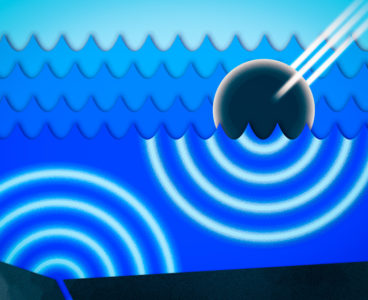
The ocean can seem like an acoustically disorienting place, with muffled sounds from near and far blending together in a murky sea of noise. Now an MIT mathematician has found a way to cut through this aquatic cacaphony, to identify underwater sound waves generated by objects impacting the ocean’s surface, such as debris from meteorites…
Missile Detection Inspires Safer Cardiac Imaging Approach
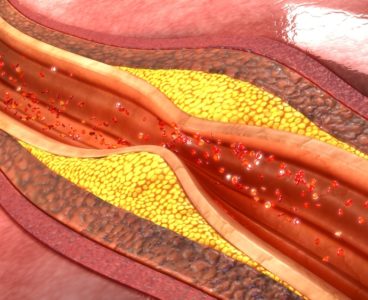
Heart disease is the leading cause of death globally, with coronary artery disease (CAD) attributed to one in seven deaths in the United States. CAD is a condition where major blood vessels that supply the heart with blood, oxygen, and other nutrients become damaged or diseased, as defined by The Mayo Clinic. A buildup of…
Seeing the Next Dimension of Computer Chips
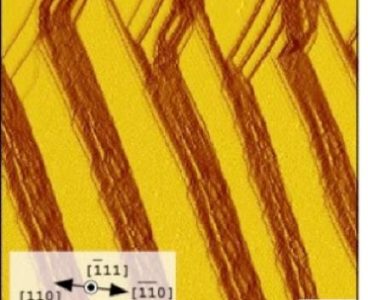
A research collaboration between Osaka University and the Nara Institute of Science and Technology for the first time used scanning tunneling microscopy (STM) to create images of atomically flat side-surfaces of 3D silicon crystals. This work helps semiconductor manufacturers continue to innovate while producing smaller, faster, and more energy-efficient computer chips for computers and smartphones.…
New Cardiac Catheter Combines Light, Ultrasound to Measure Plaques
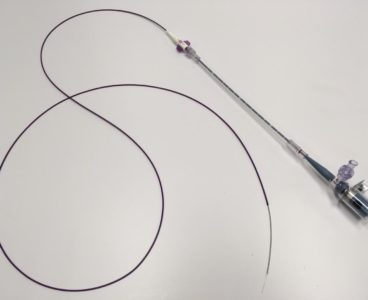
To win the battle against heart disease, cardiologists need better ways to identify the composition of plaque most likely to rupture and cause a heart attack. Angiography allows them to examine blood vessels for constricted regions by injecting them with a contrast agent before X-raying them. But because plaque does not always result in constricted…
MRI Contrast Agent Locates, Distinguishes Aggressive From Slow-Growing Breast Cancer

-A new magnetic resonance imaging (MRI) contrast agent being tested by researchers at Case Western Reserve University not only pinpoints breast cancers at early stages but differentiates between aggressive and slow-growing types. “Doing both will help doctors find the right treatment,” said Zheng-Rong Lu, the M. Frank Rudy and Margaret Dormiter Rudy Professor of Biomedical…
Rapid Imaging of Granular Matter
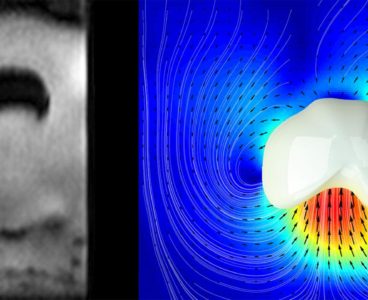
Even in our modern world full of highly technological machines and devices it is still impossible to predict when rockslides, such as the recent one in Graubünden, or earthquakes will occur and how exactly they evolve. This is partly due to the fact that despite many years of research, scientists have only just begun to…
New Microscopy Method for Reliable 3D Imaging of Curvilinear Nanostructures
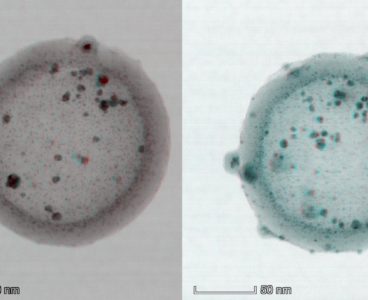
Physical and biological sciences increasingly require the ability to observe nano-sized objects. This can be accomplished with transmission electron microscopy (TEM), which is generally limited to 2D images. Using TEM to reconstruct 3D images instead usually requires tilting the sample through an arc to image hundreds of views of it and needs sophisticated image processing…
New Wrapping Material Enables High Quality Bioimaging
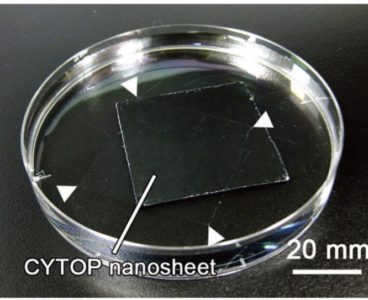
A nanosheet made of organic polymers has been developed to prevent the drying and deforming of biological samples, thus enabling high-quality imaging under microscopes. Be it cosmology or biology, the advancement of science largely relies on the advancement of measuring instruments and methodology. In the past couple of decades, scientists’ passion to see the invisible…
Fast, Economical Bioimaging Technique Created
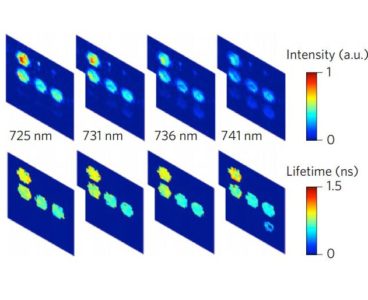
A new approach to optical imaging makes it possible to quickly and economically monitor multiple molecular interactions in a large area of living tissue — such as an organ or a small animal; technology that could have applications in medical diagnosis, guided surgery, or pre-clinical drug testing. The method, which is detailed in Nature Photonics, is…
New Terahertz Imaging Approach Could Speed Up Skin Cancer Detection
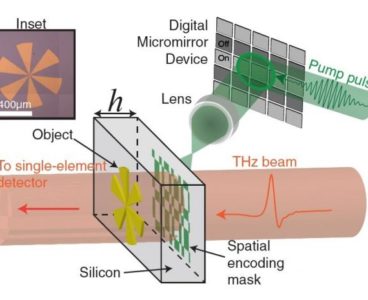
Researchers have developed a new terahertz imaging approach that, for the first time, can acquire micron-scale resolution images while retaining computational approaches designed to speed up image acquisition. This combination could allow terahertz imaging to be useful for detecting early-stage skin cancer without requiring a tissue biopsy from the patient. Terahertz wavelengths fall between microwaves…
System Creates 3D Images of Tissue Samples Without Conventional Lenses
A new system developed by UCLA researchers could make it easier and less expensive to diagnose chronic diseases, particularly in remote areas without expensive lab equipment. The technology uses extremely simple optical hardware and a lens-free microscope, as well as sophisticated algorithms that help reconstruct the images of tissue samples. It could make much-needed diagnostic…
Night Vision for Bird & Bat-Friendly Offshore Wind Power
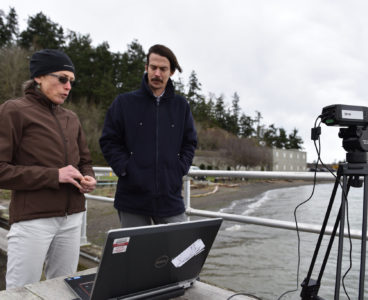
The same technology that enables soldiers to see in the dark can also help protect birds and bats near offshore wind turbines. Night vision goggles use thermal imaging, which captures infrared light that’s invisible to the human eye. Now, researchers at the Department of Energy’s Pacific Northwest National Laboratory are using thermal imaging to help birds and…
Medical Imaging Technique Proves Useful for Automotive Industry

Holograms Taken to New Dimension
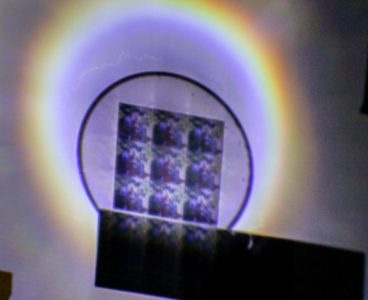
Technology developed by a team of University of Utah electrical and computer engineers could make the holographic chess game R2-D2 and Chewbacca played in “Star Wars” a reality. The team led by electrical and computer engineering associate professor Rajesh Menon has discovered a way to create inexpensive full-color 2-D and 3-D holograms that are far…
New Algorithms Extract Biological Structure from Limited Data
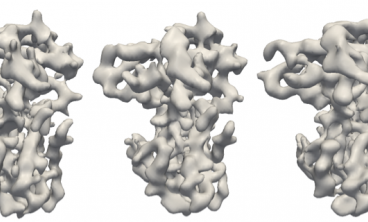
Understanding the 3D molecular structure of important nanoobjects like proteins and viruses is crucial in biology and medicine. With recent advances in X-ray technology, scientists can now collect diffraction images from individual particles, ultimately allowing researchers to visualize molecules at room temperature. However, determining 3D structure from these single-particle diffraction experiments is a significant hurdle.…
Team Developed Tumor-Targeting MRI Contrast Based on Human Protein
Novel LIDAR System Breaches Obscured Ground
Clear View on Stem Cell Development

Today, tracking the development of individual cells and spotting the associated factors under the microscope is nothing unusual. However, impairments like shadows or changes in the background complicate the interpretation of data. Now, researchers at the Technical University of Munich (TUM) and the Helmholtz Zentrum München have developed a software that corrects images to make…
How Next-Gen Thermal Imaging Can Help Keep Firefighters Safe
Thermal Imaging Cameras (TICs) are proven lifesavers for fire crews with an established track record in all phases of fire size-up, attack and, overhaul. Not only can they help firefighters find their way through thick smoke in unfamiliar surroundings, TICs can also help crews determine the center of fire activity, locate victims and other firefighters,…
Combining MRI and Optical Microscopy Promising for Brain Research

Functional magnetic resonance imaging reveals changes in blood-oxygen levels in different parts of the brain, but the data show nothing about what is actually happening in and between brain cells, information needed to better understand brain circuitry and function. “We really have no clear understanding of what cellular processes cause the MRI signal and are…
Medical Gamma-Ray Camera is now Palm-Sized

As represented by conventional radiograph, radiological images provide only black and white figures in 2D space. The situation is basically the same for Single photon emission tomography (SPECT) and positron emission tomography (PET), which are the two most common molecular imaging techniques used in nuclear medicine. PET is used especially for early cancer and Alzheimer’s…
Laser, Sound Waves Provide Live Views of Organs in Action

Biomedical engineers are now able to take a live, holistic look at the inner workings of a small animal with enough resolution to see active organs, flowing blood, circulating melanoma cells and firing neural networks. The technique dubbed “single-impulse photoacoustic computed tomography (SIP-PACT)” uses the best of both light and ultrasound to peer inside living…
‘Spectral Fingerprinting’ Sees Through Concrete to Detect Early Corrosion
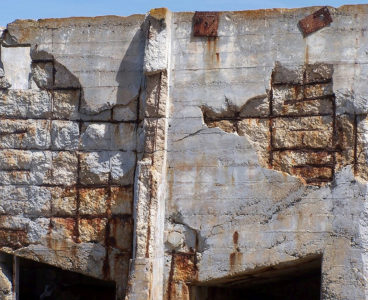
When you suffer a fall, an on-the-field collision or some other traumatic blow, the first thing the doctor will do is take an X-ray, CT scan or MRI to determine if anything has been damaged internally. Researchers at the National Institute of Standards and Technology (NIST) are using the same principle, but in a more powerful form,…
Cameras Reveal Images Hidden to the Naked Eye

EPFL researchers took advantage of the limits of human vision to hide an image in a video. The image is invisible to the human eye, but not to a camera. Human visual perception works well and is very effective at seeing what’s important to us. But our eyes are not capable of averaging video images…
Technique Makes More Efficient, Independent Holograms

Not far from where Edwin Land — the inventor of the Polaroid camera — made his pioneering discoveries about polarized light, researchers from the Harvard John A. Paulson School of Engineering and Applied Sciences (SEAS) are continuing to unlock the power of polarization. Recently, a team of researchers led by Federico Capasso, the Robert L.…