
Super-Soft Replica Organs Created with 3D Printer
Imperial College London researchers have developed a new method for creating 3D structures using cryogenics (freezing) and 3D printing techniques. This builds on previous research but is the first to create structures that are soft enough to mimic the mechanical properties of organs such as the brain and lungs. Their technique, created in collaboration with…
3D Printing Creates Super Soft Structures That Replicate Brain And Lungs
A new 3D printing technique allows researchers to replicate biological structures, which could be used for tissue regeneration and replica organs. Imperial College London researchers have developed a new method for creating 3D structures using cryogenics (freezing) and 3D printing techniques. This builds on previous research, but is the first to create structures that are…
New Hybrid Biomaterial Makes Hip Implants Last Longer
It is not something you will find in nature, but it can be created using a 3D printer and existing biomaterials: a hybrid meta-biomaterial that promotes bone growth. TU Delft researchers have developed a meta-implant that combines a conventional meta-biomaterial with an auxetic meta-biomaterial. This is important since — unlike natural materials — auxetics have…
Cutting Costs with 3D-Printed Rocket Parts

Engineers successfully hot-fire tested an RS-25 rocket engine with a large 3-D printed part for the first time on Dec. 13, marking a key step toward reducing costs for future engines that power NASA’s new heavy-lift rocket, the Space Launch System. During flight, a rocket may experience powerful up-and-down vibrations mainly due to the engines…
Molecular Printing Technology Could Recreate Chemical Environments Resembling Human Body

‘3DEAL’ is a simple and inexpensive fabrication technique able to generate complex molecular patterns within soft matter, such as hydrogels, with microscale resolution and up to centimetres in depth. This capacity enables the possibility to engineer 3D hydrogel environments with spatial control of the chemical composition, opening the opportunity to recreate biological scenarios such as…
Army Partners with Marine Corps on 3D Printed Drones

Army researchers are working with the Marines to develop 3-D printed drones as materials science, aviation technology and software development merge to deliver new capabilities. “Several years ago when we were collaborating with our academic partner, Georgia Tech, we had this project where we were focusing on design engineering of small unmanned aircraft systems,” said…
Volumetric 3D Printing Builds on Need for Speed
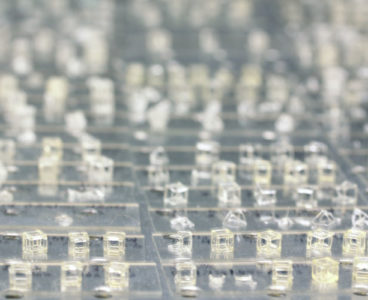
While additive manufacturing (AM), commonly known as 3D printing, is enabling engineers and scientists to build parts in configurations and designs never before possible, the impact of the technology has been limited by layer-based printing methods, which can take up to hours or days to build three-dimensional parts, depending on their complexity. However, by using…
Engineers 3D Print Framework to Grow Artificial Body Parts

Waiting on the donor list for a transplant could someday come to an end, as researchers have come one step closer to creating 3D printed, artificially grown body parts. Engineers from Penn State University believe they have created the structural framework to grow living tissues using a combination of 3D printing and electrospinning—a method that…
3D Printing Feels the Need for Speed
While additive manufacturing (AM), commonly known as 3D printing, is enabling engineers and scientists to build parts in configurations and designs never before possible, the impact of the technology has been limited by layer-based printing methods, which can take up to hours or days to build three-dimensional parts, depending on their complexity. However, by using…
Artificial Organs Created with 3D Printer
A team of researchers led by the University of Minnesota has 3D printed lifelike artificial organ models that mimic the exact anatomical structure, mechanical properties, and look and feel of real organs. These patient-specific organ models, which include integrated soft sensors, can be used for practice surgeries to improve surgical outcomes in thousands of patients…
Researchers Develop Next-Gen 3D Printed Organ Models
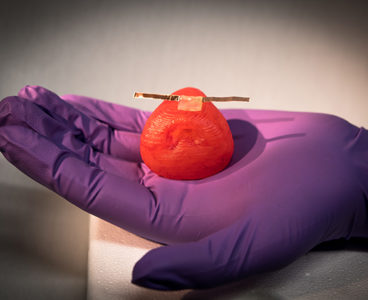
Surgeons and medical students may be able to get better practice before surgery using new artificial organ models that are more lifelike than current models. Researchers from the University of Minnesota have created artificial organ models from a 3D printer that mimic the exact anatomical structure, mechanical properties and look and feel of real organs.…
Revolutionary 3-D Printed Items Connect to WiFi without Electronics
Imagine a bottle of laundry detergent that can sense when you’re running low on soap — and automatically connect to the Internet to place an order for more. University of Washington researchers are the first to make this a reality by 3-D printing plastic objects and sensors that can collect useful data and communicate with…
3D Printed “Living” Tattoo Could be Next-Gen Wearable Device

Using a 3D printer, researchers have created a living tattoo that could be used for the next generation of wearable devices. Engineers from the Massachusetts Institute of Technology (MIT) have created a new ink from genetically programmed living cells that are engineered to light up in response to a variety of stimuli. The cells can…
New 3-D Printer Performs 10x Faster than Commercial Options

MIT engineers have developed a new desktop 3-D printer that performs up to 10 times faster than existing commercial counterparts. Whereas the most common printers may fabricate a few Lego-sized bricks in one hour, the new design can print similarly sized objects in just a few minutes. The key to the team’s nimble design lies…
Researchers Print ‘Living Materials’ With Bacteria-Loaded Inks

There will soon be nothing that cannot be produced with 3D printing. However, the materials used for this process are still “dead matter” such as plastics or metals. A group of ETH researchers led by Professor André Studart, Head of the Laboratory for Complex Materials, has now introduced a new 3D printing platform that works…
Origami Inspires 3D Printing Alternative
Inspired by the Japanese art of paper folding (origami), researchers at TU Delft are developing an alternative to 3D printing that allows the final products to have many more functionalities than what is possible with 3D printing. Those additional functionalities could, for instance, be used in medical implants or devices incorporating flexible electronics. In their…
New 3D Printer Much Faster Than Commercial Counterparts

A new desktop 3D printer boasts speeds up to 10 times faster than existing commercial printers. Researchers from the Massachusetts Institute of Technology (MIT) designed a new printer that incorporates a screw mechanism that feeds polymer material through a nozzle at high force and a laser—built into the printer’s compact printhead—that rapidly heats and melts…
Math Gets Real in Strong, Lightweight Structures

Rice University engineers are using 3-D printers to turn structures that have until now existed primarily in theory into strong, light and durable materials with complex, repeating patterns. The porous structures called schwarzites are designed with computer algorithms, but Rice researchers found they could send data from the programs to printers and make macroscale, polymer models for…
The Building Material of the Future?
Rice University engineers are using 3-D printers to turn structures that have until now existed primarily in theory into strong, light and durable materials with complex, repeating patterns. The porous structures called schwarzites are designed with computer algorithms, but Rice researchers found they could send data from the programs to printers and make macroscale, polymer…
Researchers Find New Way to 3D Print Electronic Circuits
Scientists have created a new method to print electronic circuits using a 3D printer. A team of researchers from the University of Nottingham can now rapidly 3D print fully functional electronic circuits that contain electrically-conductive metallic inks and insulating polymeric inks, which could be useful for medical devices, radio frequency shielding surfaces and novel structures…
3D Printed Device Builds Better Nanofibers
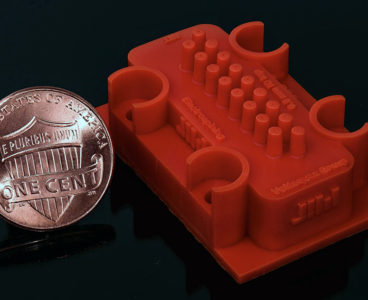
Meshes made from fibers with nanometer-scale diameters have a wide range of potential applications, including tissue engineering, water filtration, solar cells, and even body armor. But their commercialization has been hampered by inefficient manufacturing techniques. In the latest issue of the journal Nanotechnology, MIT researchers describe a new device for producing nanofiber meshes, which matches the…
One-Step 3D Printing of Catalysts Developed
The U.S. Department of Energy’s Ames Laboratory has developed a 3D printing process that creates a chemically active catalytic object in a single step, opening the door to more efficient ways to produce catalysts for complex chemical reactions in a wide scope of industries. While 3D printing has found applications in many areas, its use…
Lab Researchers Achieve Breakthrough in 3D-printed Marine-grade Stainless Steel
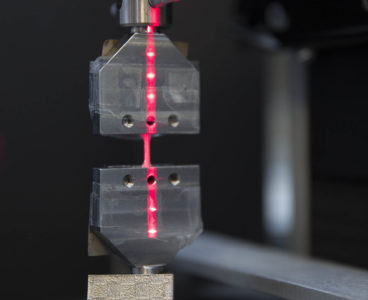
“Marine grade” stainless steel is valued for its performance under corrosive environments and for its high ductility — the ability to bend without breaking under stress — making it a preferred choice for oil pipelines, welding, kitchen utensils, chemical equipment, medical implants, engine parts and nuclear waste storage. However, conventional techniques for strengthening this class…
Breakthrough Made in 3D Printed Marine Grade Stainless Steel
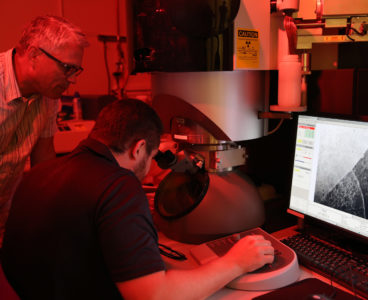
“Marine grade” stainless steel is valued for its performance under corrosive environments and for its high ductility — the ability to bend without breaking under stress — making it a preferred choice for oil pipelines, welding, kitchen utensils, chemical equipment, medical implants, engine parts and nuclear waste storage. However, conventional techniques for strengthening this class…